At the start of 2026, a new trend is dominating Google Discover and X (formerly Twitter) feeds. It’s not about hyper-realistic studio photography or fantasy art; it is about self-reflection through artificial intelligence.
The “Most Popular New ChatGPT Prompt for Photo Generation Today” isn’t asking for a better sunset or a cooler car—it is asking the AI to look back at you. This movement, dubbed the “Personal User Manual” or “Self-Portrait Prompt,” has gone viral because it turns ChatGPT into a mirror, visualizing your digital soul based on your chat history. Vid9
Why is This Going Viral in 2026?
The timing of this trend is critical. We are currently witnessing a massive leap in AI capabilities. With the launch of ChatGPT Image 2.0 and Google’s “Nano Banana 2,” AI can now render perfect text and complex layouts without the “gibberish” errors of the past . Because the AI can finally write clean Traditional Chinese, Japanese, and English text on images, these manuals look like legitimate published zines.
Furthermore, this trend satisfies a deep psychological need. In a noisy digital world, people crave introspection. Users are sharing these results on social media not just to show off the AI, but to say, “This is how the AI sees me—does this match who I am?” .
Breaking Down the Visual Design
To rank on Google Discover, visuals must be high-quality and unique. The “Personal Manual” aesthetic dominates because it is text-heavy but visually digestible. According to viral posts, the most shared layout includes:
- A Hero Avatar: A stylized portrait of the user.
- Stats & KPIs: Quirky metrics like “Creativity: 99%” or “Coffee Dependency: High.”
- Instruction Manual Icons: Visuals showing “Best ways to communicate with me” or “Do Not Disturb when working.”
How to Create Your Own Viral Manual
To get the “Most Popular” result seen on Reddit and X this week, you cannot just copy-paste a short sentence. You must structure your prompt for AI readiness .
1. Activate Memory
Ensure ChatGPT’s memory is on. The more you have talked about your job, your favorite movies, or your daily struggles over the past months, the more accurate the result will be .
2. Use the ‘Reverse Prompt’ Technique
Instead of telling the AI who you are, ask it to prove it knows you.
- Example: “Do not make up traits. Only extract traits from our chat history. If you aren’t sure, leave it blank.”
3. Specify the 2026 Aesthetic
The “2026 style” is distinct from last year’s “glassmorphism.” Currently, Wabi-Sabi minimalism and Cyber-Showa (retro Japanese analog) are trending for these manuals .
What is the ‘Personal User Manual’ Prompt?
Unlike standard prompts where you describe a scene, this prompt asks ChatGPT to analyze your past conversations. It leverages the model’s advanced memory and the new GPT Image 2.0 capabilities (released April 2026) to generate a detailed infographic about you .
Prompt:
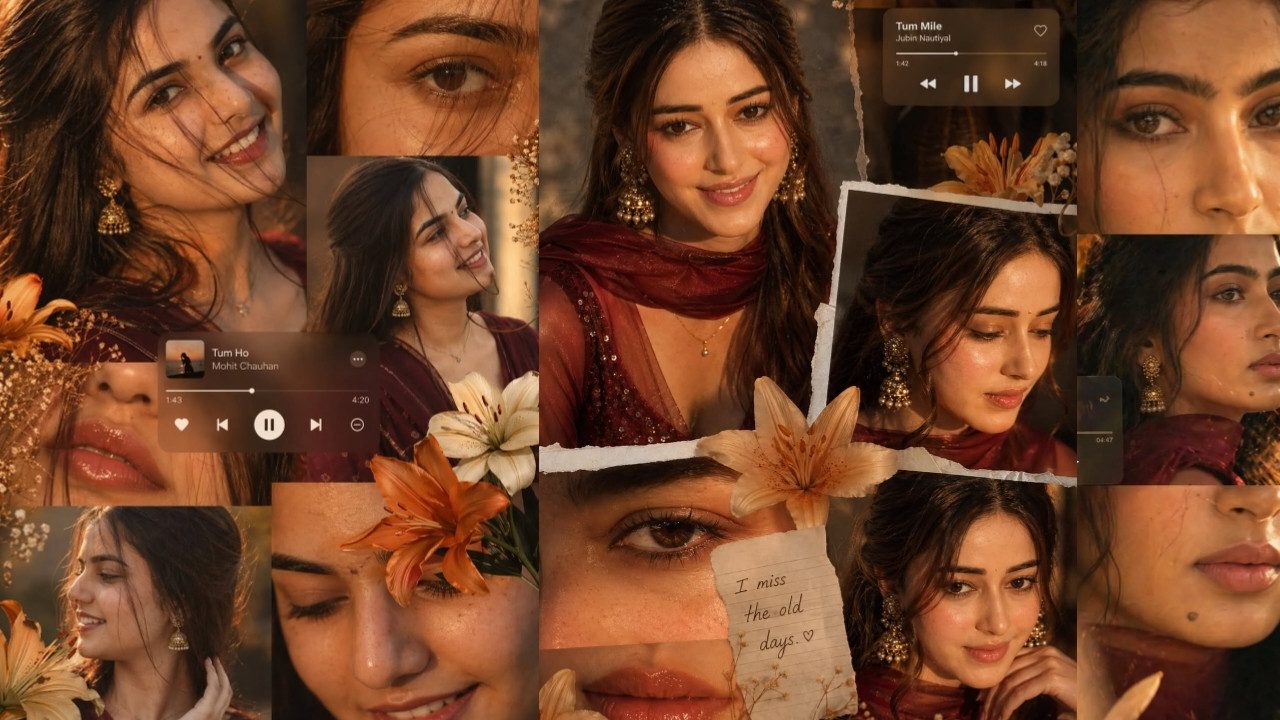
Add A warm-toned cinematic portrait collage of a young woman with soft glowing skin, subtle freckles, and glossy nude lips. She has long dark brown hair styled in loose waves with face-framing strands. She is wearing traditional gold jhumka earrings and a delicate necklace, dressed in a deep maroon outfit with a sheer dupatta around the neck. The lighting is golden-hour inspired with rich amber highlights and soft shadows, creating a cozy, intimate mood.
The composition is a collage layout with multiple cropped frames of her face-close-ups of eyes, lips, and side profile-arranged aesthetically. Add soft floral elements like beige and orange lilies placed around the frame. Include a blurred music player overlay showing a song playing for a nostalgic vibe. Skin appears dewy and radiant, with minimal elegant makeup.
Style: soft glam, editorial, aesthetic Instagram collage, warm color grading, high detail, shallow depth of field, cinematic lighting, 4K, ultra-realistic.
Conclusion
The “Personal User Manual” is the definitive prompt of Q2 2026 because it showcases the new frontier of AI: Personality. We have moved past “make this pretty” to “understand who I am.”
If you want to go viral, generate your manual and post the results side-by-side with a screenshot of the prompt. Viewers aren’t just looking at a picture; they are trying to decode the relationship between you and the machine.